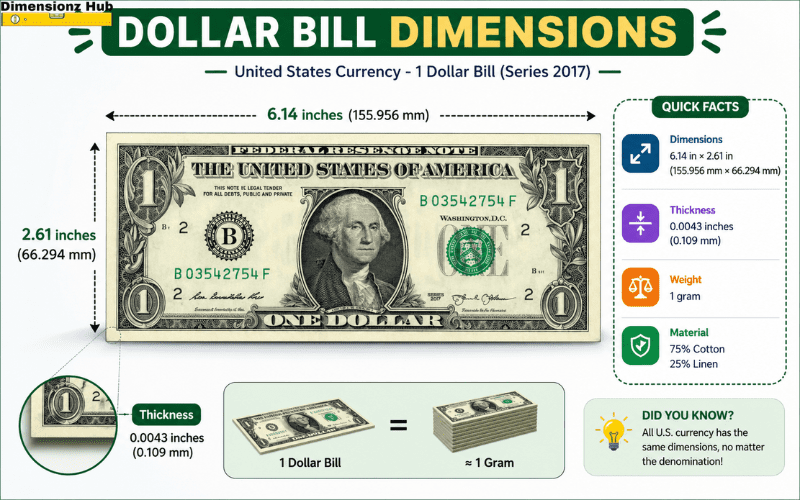

What are dollar bill dimensions? A standard US dollar bill measures 6.14 inches long (15.6 cm) and 2.61 inches wide (6.63 cm).
The size of a dollar bill is carefully standardized to ensure consistency in printing, handling, storage, and machine processing. Every US banknote, regardless of denomination, follows the same dimensions, making it easier to use in wallets, ATMs, and vending machines.
In this complete guide, you will learn everything about dollar bill length, width, size, structure, design, and practical uses in simple and clear language.
What Is the Size of a Dollar Bill?
A dollar bill is a rectangular paper currency note used in the United States.
Standard size:
- Length: 6.14 inches (15.6 cm)
- Width: 2.61 inches (6.63 cm)
These dimensions are used for all denominations, including $1, $5, $10, $20, $50, and $100 bills.
Dollar Bill Length (Detailed Explanation)
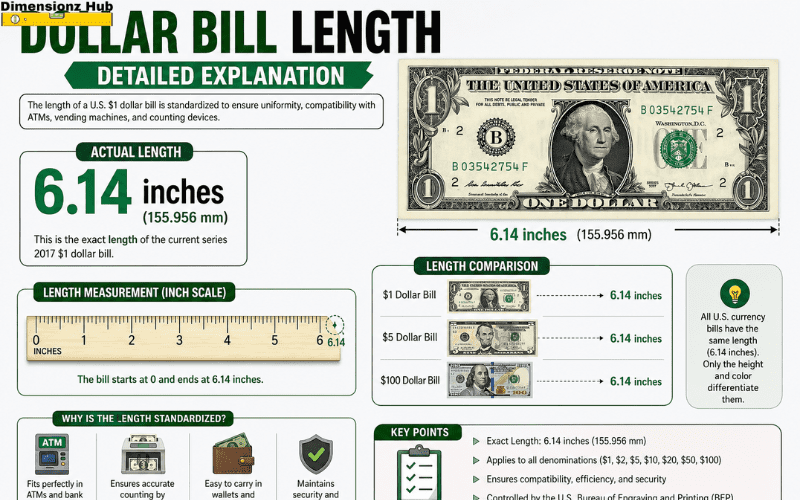
The length of a dollar bill is:
- 6.14 inches (15.6 cm)
Why this length is used
This length is designed to:
- Fit easily into wallets and pockets
- Work efficiently with counting machines
- Provide enough space for printed details
- Maintain durability during daily use
The length has remained unchanged for decades to ensure consistency.
Dollar Bill Width
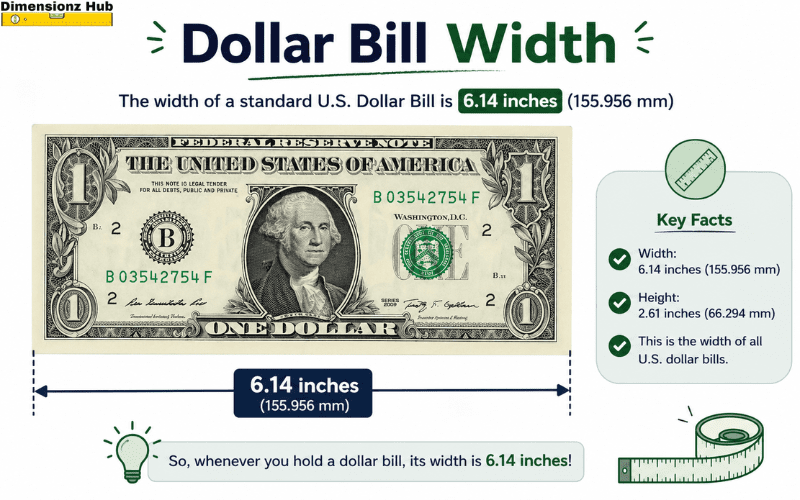
The width of a dollar bill is:
- 2.61 inches (6.63 cm)
Why width matters
The width ensures:
- Easy handling
- Proper stacking
- Compatibility with ATMs and cash registers
A balanced width makes the bill neither too large nor too small for everyday use.
Dollar Bill Dimensions Table
| Measurement | Inches | Centimeters |
| Length | 6.14 in | 15.6 cm |
| Width | 2.61 in | 6.63 cm |
| Aspect Ratio | ~2.35:1 | — |
| Thickness | ~0.0043 in | 0.11 mm |
Why All Dollar Bills Have the Same Size
All US dollar bills share identical dimensions.
Reasons include:
- Easy machine processing
- Faster counting and sorting
- Simplified printing process
- Uniform storage and handling
This standardization improves efficiency across financial systems.
Material and Structure of Dollar Bills
Dollar bills are not made from regular paper.
They are made of:
- 75% cotton
- 25% linen
Why this material is used
- Strong and durable
- Resistant to tearing
- Long-lasting in circulation
- Unique texture for authenticity
This composition helps bills survive frequent use.
Thickness and Flexibility
A dollar bill is very thin but strong.
- Thickness: about 0.0043 inches (0.11 mm)
Why thickness matters
Thin bills:
- Save space in storage
- Allow easy stacking
- Work smoothly in machines
Despite being thin, they remain flexible and durable.
Historical Changes in Dollar Bill Size
Dollar bill dimensions were not always the same.
Before 1929:
- Larger size notes were used
After 1929:
- Size was reduced to current dimensions
Why size changed
The reduction helped:
- Lower printing costs
- Improve storage efficiency
- Standardize currency
This modern size is still used today.
Design Layout of a Dollar Bill
The dimensions allow space for various design elements.
These include:
- Portrait image
- Serial numbers
- Security features
- Text and symbols
Each element is carefully placed within the given size.
Security Features and Their Placement
Dollar bills include multiple security features.
Examples:
- Watermarks
- Security threads
- Color-shifting ink
Why dimensions matter here
The size ensures these features fit properly and remain consistent across all bills.
Practical Uses of Dollar Bill Dimensions
Understanding dollar bill size helps in:
- Designing wallets
- Creating cash storage systems
- Building vending machines
- Studying currency design
It is useful in both daily life and industrial applications.
Storage and Handling Efficiency
Dollar bill dimensions are optimized for efficient handling.
Benefits include:
- Easy stacking in bundles
- Compact storage in banks
- Smooth machine processing
- Convenient everyday use
Uniform size makes large-scale handling easier.
Comparison With Other Currencies
Different countries use different banknote sizes.
US dollar 특징:
- Same size for all denominations
- Simple and uniform design
Other currencies may vary in size depending on value.
Why Dollar Bill Dimensions Matter
These dimensions are important because they affect:
- Usability
- Storage
- Security features
- Machine compatibility
Even small changes could disrupt financial systems.
Simple Way to Remember Dollar Bill Size
A simple way to remember:
👉 6.14 inches long and 2.61 inches wide
Explore More.
- Monster Can Dimensions: Height, Width, Length, Size, Volume & Complete Guide
- Badminton Court Dimensions: Size, Length, Width, Measurements & Complete Guide
- iPhone Wallpaper Dimensions: Sizes, Resolution, Width, Height & Complete Guide
- Coke Can Dimensions: Height, Width, Length, Size, Volume & Complete Guide
- Red Bull Can Dimensions: Height, Width, Length, Size, Volume & Complete Guide
FAQs
What is the size of a dollar bill?
It is 6.14 × 2.61 inches (15.6 × 6.63 cm).
Are all US bills the same size?
Yes, all denominations use the same dimensions.
What material is used in dollar bills?
They are made of cotton and linen blend.
Why are dollar bills small?
To improve efficiency in printing, storage, and handling.
When was the current size introduced?
In 1929, the modern size was standardized.
Related post: Coke Can Dimensions: Height, Width, Length, Size, Volume & Complete Guide
Conclusion
Dollar bill dimensions are carefully designed to ensure consistency, durability, and efficiency. The length, width, and material all work together to create a practical and long-lasting currency.
By understanding these measurements, you gain insight into how currency design supports everyday transactions and large-scale financial systems.