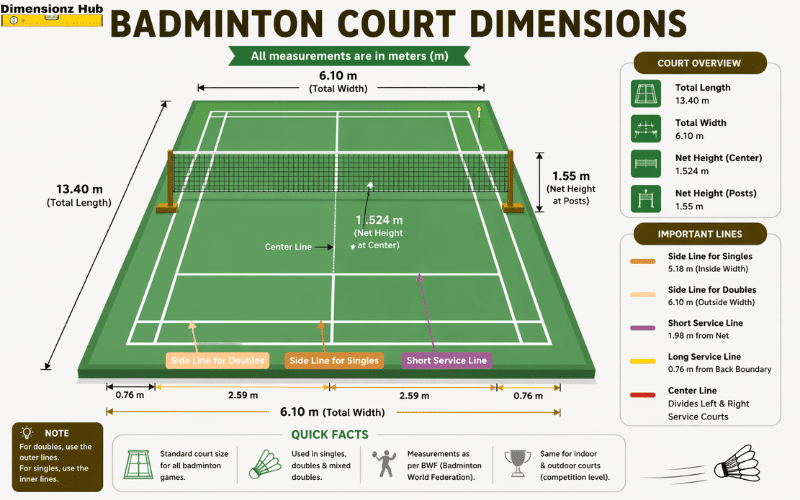

What are badminton court dimensions? A standard badminton court is 44 feet long (13.4 meters) and 20 feet wide (6.1 meters) for doubles, while singles width is 17 feet (5.18 meters).
Badminton court dimensions are officially defined to maintain fairness, consistency, and balance in gameplay. Every measurement, from court length to service lines, plays an important role in how the game is played. Whether you are a beginner, a casual player, or a professional, understanding these dimensions helps improve positioning, shot accuracy, and overall performance.
In this complete guide, you will learn everything about badminton court length, width, layout, markings, net height, spacing, and practical usage in simple and easy-to-understand language.
What Is the Size of a Badminton Court?
A badminton court is a rectangular playing surface divided into two equal halves by a net.
Standard dimensions:
- Length: 44 feet (13.4 meters)
- Width (Doubles): 20 feet (6.1 meters)
- Width (Singles): 17 feet (5.18 meters)
The court is marked with clearly defined boundary lines that determine the playing area for both singles and doubles matches. These measurements are standardized globally, meaning courts in different countries follow the same dimensions.
Badminton Court Length (Detailed Explanation)
The length of a badminton court is:
- 44 feet (13.4 meters)
Why this length is important
This length is designed to create a balance between offensive and defensive gameplay. It allows players to perform a wide range of shots such as clears, smashes, and drop shots.
The length also ensures:
- Enough space for backcourt rallies
- Proper movement from front to back
- Strategic shot placement
Since both singles and doubles use the same court length, players must adapt their gameplay depending on court width and positioning.
Badminton Court Width (Singles vs Doubles)
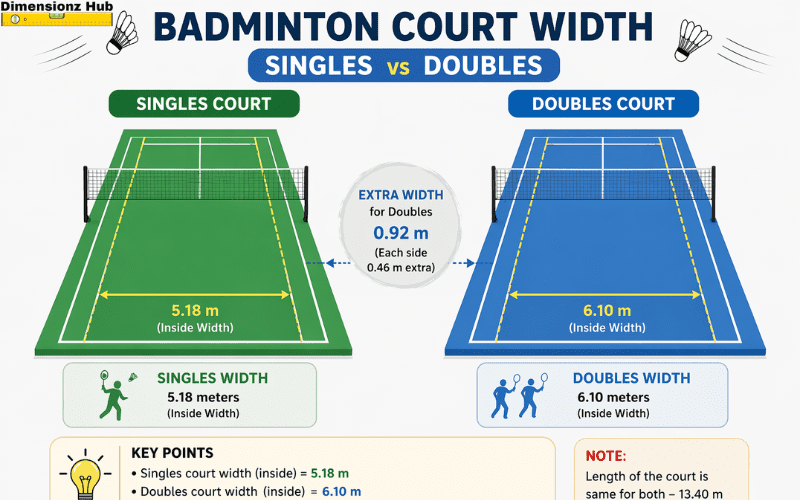
The width of a badminton court changes depending on the type of match.
Doubles Width
- 20 feet (6.1 meters)
Singles Width
- 17 feet (5.18 meters)
Why width changes
In singles matches, a narrower court reduces the area each player must cover, making the game more focused and physically balanced.
In doubles matches, a wider court increases the playing area, allowing players to use teamwork, angles, and positioning strategies.
This variation makes the game more dynamic and adaptable.
Related Post: iPhone Wallpaper Dimensions: Sizes, Resolution, Width, Height & Complete Guide
Badminton Court Dimensions Table
| Measurement | Feet | Meters |
| Length | 44 ft | 13.4 m |
| Width (Doubles) | 20 ft | 6.1 m |
| Width (Singles) | 17 ft | 5.18 m |
| Net Height (Center) | 5 ft | 1.524 m |
| Net Height (Posts) | 5 ft 1 in | 1.55 m |
Badminton Net Height
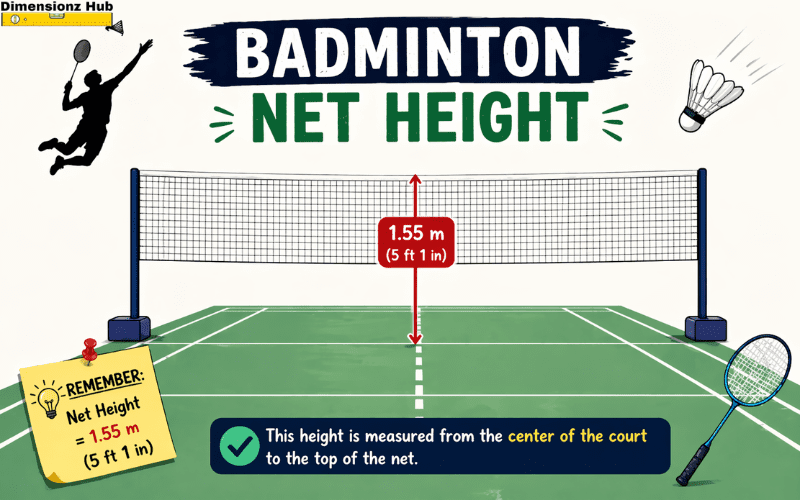
The net height is a key element of court dimensions.
- Center: 5 feet (1.524 meters)
- Posts: 5 feet 1 inch (1.55 meters)
Why net height matters
The net acts as a barrier that players must hit the shuttle over. Its height is carefully balanced to ensure:
- Fair competition
- Skill-based gameplay
- Equal challenge for both players
Even small variations in net height can affect the difficulty of shots and the overall game.
Court Lines and Markings
Badminton courts include multiple lines that define different areas.
Main markings:
- Baseline (back boundary)
- Sidelines (side boundaries)
- Center line
- Short service line
- Long service line
Importance of markings
These lines are essential because they:
- Define legal play areas
- Help players position correctly
- Ensure rules are followed
Each line has a specific function, especially during service and rally play.
Singles vs Doubles Court Layout
There are important layout differences between singles and doubles matches.
Singles Layout
- Narrow court
- Full length used
- Longer service area
Doubles Layout
- Wider court
- Shorter service area
- More strategic positioning
Why layout differs
The layout is adjusted to match the number of players. Singles focus more on endurance and precision, while doubles focus on teamwork and quick reactions.
Court Surface and Flooring Types
Badminton courts can have different surface types.
Common surfaces:
- Wooden flooring
- Synthetic mats
- Rubberized surfaces
Why surface matters
The surface affects:
- Player movement
- Grip and stability
- Injury prevention
Professional courts use high-quality materials to ensure safety and performance.
Space Requirements Around the Court
In addition to court dimensions, extra space is required around the playing area.
Recommended space:
- At least 2 to 4 feet clearance on all sides
Why extra space is needed
Players often move beyond boundary lines during gameplay. Extra space ensures:
- Safety
- Freedom of movement
- Reduced risk of injury
Without proper spacing, gameplay can become restricted and unsafe.
Indoor vs Outdoor Court Considerations
Badminton is mainly played indoors, but outdoor courts also exist.
Indoor courts:
- No wind interference
- Better lighting control
- Standard professional setup
Outdoor courts:
- Same dimensions
- Weather conditions affect gameplay
Wind can change shuttle direction, making outdoor play more challenging.
Role of Court Dimensions in Player Performance
Court dimensions directly impact how players perform during a match.
They influence:
- Movement patterns
- Shot selection
- Positioning strategy
- Reaction time
Players train based on these dimensions to improve their speed, accuracy, and control.
Importance of Standardized Dimensions
Standardization ensures that badminton is played fairly across the world.
Benefits include:
- Equal competition conditions
- Consistent training environments
- Accurate rule enforcement
- International compatibility
Whether you play locally or internationally, the court size remains the same.
Practical Uses of Badminton Court Dimensions
Understanding court dimensions is useful for:
- Setting up courts at home or clubs
- Coaching and training sessions
- Organizing tournaments
- Designing sports facilities
It also helps players visualize space better during matches.
Simple Way to Remember Court Size
An easy way to remember:
👉 44 feet long and 20 feet wide (doubles)
👉 17 feet wide for singles
This simple formula helps you quickly recall the dimensions.
Explore More.
FAQs
What is the length of a badminton court?
The length is 44 feet (13.4 meters).
What is the width of a badminton court?
It is 20 feet for doubles and 17 feet for singles.
What is the height of the badminton net?
The net height is 5 feet at the center.
Are singles and doubles courts different?
Yes, singles courts are narrower than doubles courts.
Why are badminton courts rectangular?
The rectangular shape allows balanced movement and fair gameplay.
Related Post: Coke Can Dimensions: Height, Width, Length, Size, Volume & Complete Guide
Conclusion
Badminton court dimensions are carefully designed to create a balanced and competitive game. Every measurement, from length and width to net height and markings, plays an important role in gameplay.
By understanding these dimensions in detail, you can improve your knowledge of the sport, enhance your performance, and ensure proper court setup for both practice and professional matches.